03 - Core Concepts

Core Concepts
In short: Five simple ideas decide whether a page converts. You do not need them to publish, but they make every page better.
You can publish your first page without reading this. But once you understand these five ideas, you will write sharper briefs and get pages that actually convert.
We will keep using IM8 and their Daily Ultimate Essentials Pro, an all-in-one supplement, as the example, the same brand from Quick Start.
1. A campaign page is not your storefront
In short: Your storefront serves everyone. A campaign page serves one buyer, one angle, one action.
A storefront has a menu, a full catalog, and many ways to wander off. That is fine for browsing. It is bad for a paid click, where every extra path is a chance to leave.
A campaign page does the opposite. One persona. One angle. One button. Everything else is removed.
That is why Flunnel builds a separate page per angle, instead of sending ads to a product page written for everyone.
2. Meet buyers where they are
In short: Not everyone who clicks is ready to buy. The page has to match how ready they are.
Think about the same shopper at five different moments:
They have never thought about their daily supplement routine at all.
They are tired of juggling several separate pills each morning, but have not looked for a fix.
They start to suspect a single all-in-one supplement could simplify things.
They have seen IM8 Daily Ultimate Essentials Pro and are comparing it to two other all-in-one options.
They just want the price, the subscription terms, and a reason to start now.
Each moment needs a different page. The shopper in moment 1 needs a story that earns attention first. The shopper in moment 5 finds that story slow and just wants the offer.
These five moments are called the awareness ladder (from marketer Eugene Schwartz), and you pick one for every page.
Quick tip: Picking the wrong moment is the most common reason a well-written page still fails. Be honest about how ready your traffic really is.
3. Carry one key message from ad to page
In short: The ad and the page should make the same core promise. The exact wording can change, and testing tells you which version works.
Your ad and your page should share one key message, the central idea that earned the click. When a visitor clicks an ad promising one thing and lands on a page that promises something else, the click goes cold and they leave. When the page picks up the same promise, they keep reading.
That core promise is called the anchor phrase, and keeping it consistent from ad to page is called message-match.
Message-match is about the message, not the exact words. You can express the same promise in several ways and test them. For IM8, the key message might be "one supplement replaces many." One ad headline could say "One scoop instead of a cabinet of pills," another could say "Cancel the rest of your supplement shelf." Both carry the same anchor, and you learn which phrasing converts best.
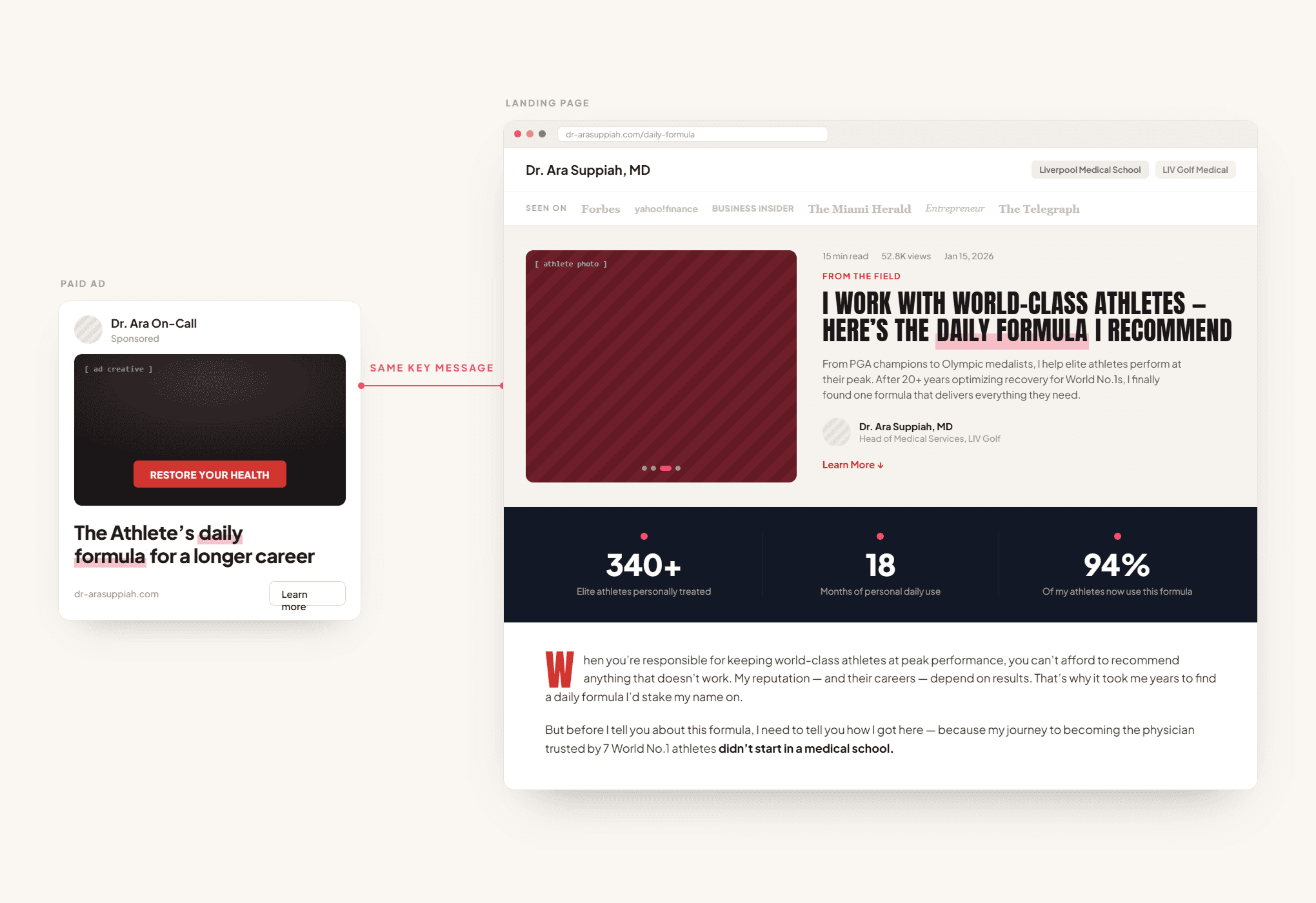
You set the anchor phrase once in the brief. Flunnel keeps that core promise front and center on the page, so the match is intentional, while you stay free to test different wordings.
4. Follow a proven structure
In short: A copy framework is just the order the page makes its argument in. You pick one, the writing follows it.
Instead of guessing the order of your pitch, you choose a proven shape. Flunnel includes seven, and you pick one in the brief. Here are the common ones:
Framework | The order it follows | Use it when |
|---|---|---|
PAS | Name the pain, make it sting, then solve it | The visitor already feels the problem |
PASTOR | PAS plus proof, an offer, and a close | Long advertorials that need proof |
BAB | Life now, life better, the bridge between | Products with a clear before and after |
AIDA | Hook, interest, desire, action | Broad or cold traffic |
Star, Story, Solution | A hero, a story, the payoff | Founder and customer stories |
Reason-Why | A list of concrete reasons to believe | Skeptical, proof-driven buyers |
You will see the full list of seven when you choose one. Framework and awareness moment work together, and Best Practices shows how to pair them.
5. Set your brand look once
In short: Save your colors and fonts once. Every future page uses them automatically.
You store your brand colors and fonts as reusable settings: a main color, a second color, a background color, and your fonts. Saved together, these are called a scheme.
Build ten pages and they all look like your brand, because they all pull from the same scheme. Logos and color schemes can also be generated from your brand colors.
6. The page and the emails are one set
In short: Every page comes with three matching emails that continue the same story.
Flunnel does not build the page and the emails separately. One run makes the page first, then three emails: a Welcome, a Value email, and an Offer email.
They pick up the same angle and the same promise. The visitor reads the page, opts in, and the inbox keeps making the same case in the same voice.
Putting it together
A page that converts gets all of these right at once:
Speaks to one persona at the right awareness moment.
Repeats the ad's anchor phrase.
Follows a framework that fits that moment.
Looks consistently on brand.
Hands off to an email flow that continues the story.
The brief is where you set all of this. The next two pages show you how.
Continue to The 12 Landing Page Types · Jump to the Step-by-Step Guide
Share: