04 - The 12 Landing Page Types
The 12 Landing Page Types
In short: Flunnel has twelve page types. Pick the one that matches your traffic, then a template inside it.
Each type has its own structure, tone, and use case. Each one comes with several ready-made templates. You pick a type first, then a template, so you never start from a blank page.
This page is a reference. Skim the table, then read the type you need. Not sure which? Jump to How to choose at the end.
Overview
Type | Best for |
|---|---|
Advertorial / Native Article | Long-form editorial for cold traffic |
Listicle / Top List | A scan-first, top-N article |
VSL (Video Sales Letter) | Video first, with supporting copy |
Quiz / Interactive | A lead-generating quiz funnel |
Comparison / vs Competitor | A head-to-head breakdown |
Testimonial / Customer Story | A single hero customer arc |
UGC / Influencer Wall | A grid of social proof |
Before / After / Demo | Visual proof of the outcome |
Expert / Doctor Recommend | An authority-led explainer |
Founder / Brand Origin | A founder letter or origin story |
Product Detail (PDP-DR) | A direct-response product page |
Bundle / Offer Page | A hard-offer landing page |
Three families
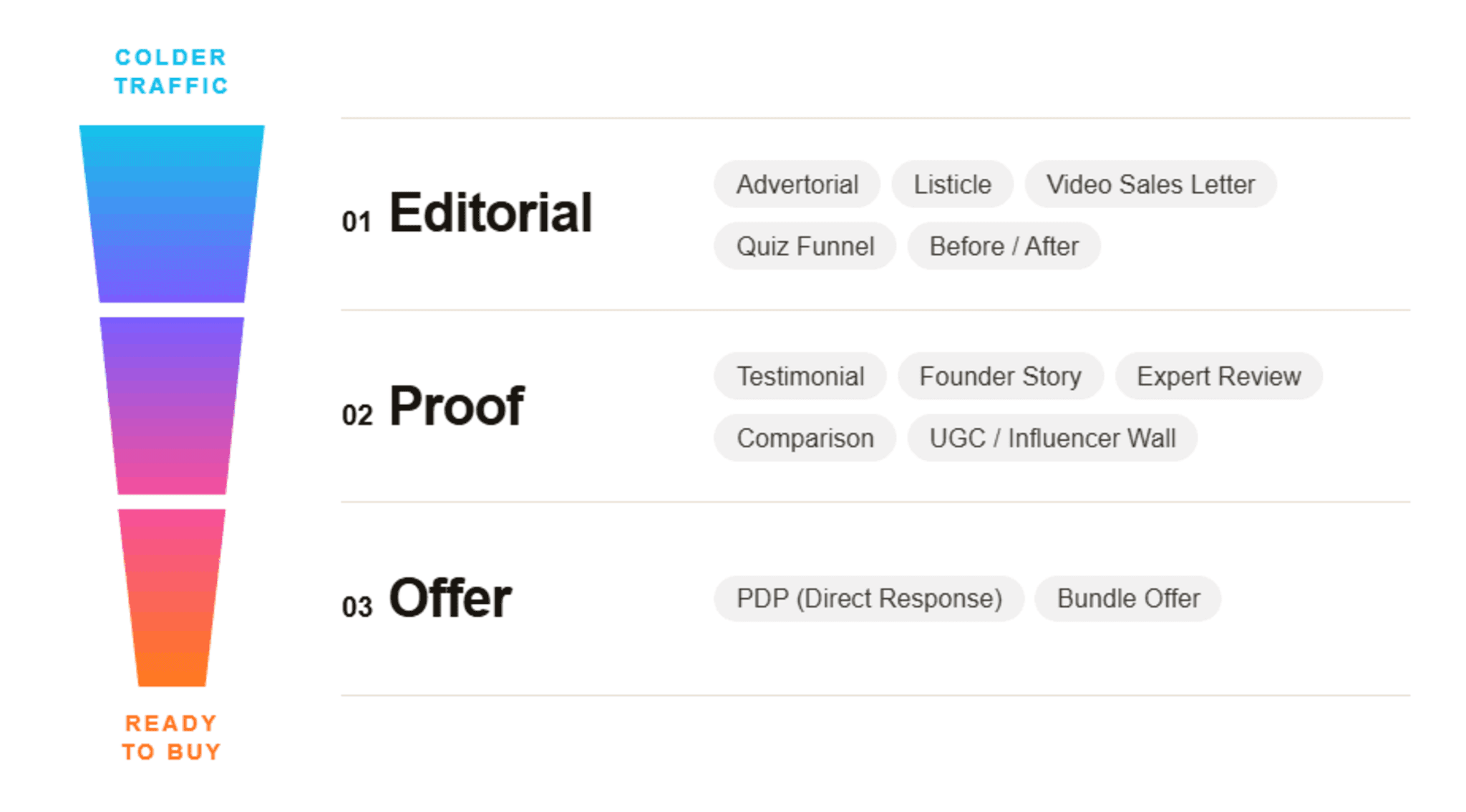
In short: The twelve types fall into three groups by how they persuade: with a Story, with Proof, or with an Offer.
Which group you need depends on how ready your traffic is, the awareness moment from Core Concepts.
Colder traffic that does not know you yet usually needs an Editorial page to earn attention.
Comparison shoppers respond to Proof.
Ready buyers convert on an Offer.
Family | What it leans on | Types |
|---|---|---|
Editorial | A story that earns attention | Advertorial, Listicle, VSL, Founder / Brand Origin |
Proof | Evidence that convinces | Comparison, Testimonial, UGC Wall, Before / After / Demo, Expert / Doctor |
Offer | A deal a ready buyer acts on | Quiz / Interactive, Product Detail (PDP-DR), Bundle / Offer Page |
Editorial types
Advertorial / Native Article. Reads like an article, not an ad, so skeptical readers keep going. Best for cold traffic that does not know it has a problem yet. For Aerix, it could open with a player's frustration over losing control, long before the racket appears.
Listicle / Top List. A scannable top-N article, often built on ranked cards. Best when the reader is browsing and your angle is "the best options for X."
VSL (Video Sales Letter). Led by a video, with copy beneath for scrollers. Best when a demo or spoken pitch sells better than text.
Founder / Brand Origin. A founder letter or origin story that builds trust through the person behind the product. Best when your story is the thing that sets you apart.
Proof types
Comparison / vs Competitor. A head-to-head breakdown against the two or three rivals you lose sales to. Best for shoppers who already know the category and need a reason to choose you. For Aerix, line the Matchpoint Elite up against the rackets a club player is weighing.
Testimonial / Customer Story. One hero customer's arc, from problem to result, in depth. Best when a single strong story beats many short quotes.
UGC / Influencer Wall. A grid of creator and customer content, often a masonry wall. Best when volume and authenticity of proof are your strongest cards.
Before / After / Demo. Built around visual proof of the change the product makes. Best when seeing the difference beats reading about it.
Expert / Doctor Recommend. An explainer that borrows credibility from an expert. Best for categories where trust and safety matter most.
Offer types
Quiz / Interactive. A multi-step quiz that engages the visitor and captures a lead while guiding them to the right product. Best for collecting leads and qualifying interest.
Product Detail (PDP-DR). A direct-response product page, often with a sticky buy box that follows the reader. Best for buyers who are close to deciding and mainly need facts, proof, and an easy path to buy.
Bundle / Offer Page. A hard-offer page built around one deal or bundle. Best for ready buyers who just need the offer and a reason to act now.
Templates inside each type
In short: Every type holds several finished templates, so you choose a layout, not a blank page.
Examples you will see include a sticky buy box, a gallery-first layout, a masonry UGC wall, ranked cards, and a multi-step quiz. Each template carries its own structure and writing rules, so the layout and the copy are built to work together.
How to choose
In short: Choose from your traffic, not your taste. Two questions get you there.
How ready is this traffic? Not aware yet points to an Editorial type. Comparing options points to a Proof type. Ready to buy points to an Offer type.
What is your strongest asset? A story suggests Advertorial or Founder. A video suggests VSL. Lots of social proof suggests UGC or Testimonial. A visible result suggests Before / After. A specific deal suggests Bundle / Offer.
Quick tip: For cold paid traffic and when unsure, start with the Advertorial. It is a safe, high-performing default, which is why Quick Start uses it.
Back to Core Concepts · Continue to the Step-by-Step Guide
Share: